Recent Posts


The Future of Container Shipping: Trends Businesses Should Watch
March 31, 2026
Introduction
Container shipping is the engine of global trade. More than 80 percent of all internationally traded goods travel by sea at some point in their journey, and the overwhelming majority of that cargo moves inside the standardized steel boxes that have defined international logistics since the 1950s. The container revolutionized global trade once before. It is about to be transformed again.
The container shipping industry is entering a period of accelerated change driven by forces that are simultaneously technological, environmental, geopolitical, and commercial. Green fuel mandates are forcing carriers to reinvent their propulsion systems. Digitalization is replacing paper-based processes with intelligent data platforms. Mega vessels are reshaping port infrastructure requirements. Geopolitical tensions are redrawing trade routes. And the customers of container shipping services are demanding levels of visibility, reliability, and flexibility that the industry of the past was simply not built to deliver.
For businesses that rely on container shipping to move their goods, understanding these trends is not simply a matter of intellectual interest. It is a practical necessity for making sound decisions about supply chain strategy, carrier relationships, and logistics investment. The companies that understand where container shipping is heading will be better positioned to adapt their operations, manage their costs, and build the supply chain resilience that the coming decade demands.
At LTB Shipping, we monitor industry developments continuously so that our clients benefit from informed guidance that keeps their logistics strategy ahead of the curve. This blog examines the most significant trends shaping the future of container shipping and what they mean for businesses that depend on it.
1. The Green Shipping Revolution
1.1 Why Decarbonization Is the Defining Challenge of Container Shipping’s Future
The shipping industry is responsible for approximately 2.5 to 3 percent of global greenhouse gas emissions annually, a figure comparable to the emissions of a major industrialized nation. As international pressure to address climate change has intensified, the shipping industry has come under increasing regulatory and commercial pressure to decarbonize its operations fundamentally.
The International Maritime Organization, the United Nations body responsible for regulating global shipping, has set ambitious targets for reducing shipping emissions. Its revised greenhouse gas strategy calls for net zero emissions from international shipping by or around 2050, with significant interim milestones requiring substantial emissions reductions by 2030 and 2040. These targets have transformed from aspirational goals into hard regulatory realities that shipping lines must now plan and invest around seriously.
For carriers, meeting these targets requires nothing less than a complete overhaul of the fuels that power the global fleet. The internal combustion of conventional heavy fuel oil that has powered ocean shipping for over a century must be replaced by alternative propulsion systems and fuels that either produce no carbon emissions or capture and offset whatever carbon they do produce.
1.2 Alternative Fuels Competing for Dominance
The transition to green shipping fuels is not following a single clearly defined path. Several alternative fuel technologies are currently competing for dominance, and the outcome of that competition will shape the economics of container shipping for decades to come.
Liquefied Natural Gas became the first widely adopted lower-emission marine fuel, offering meaningful reductions in sulfur oxides, nitrogen oxides, and particulate matter compared to conventional heavy fuel oil, along with moderate reductions in carbon dioxide emissions. Many major carriers invested heavily in LNG-capable vessels over the past decade. However, LNG is now increasingly viewed as a transitional fuel rather than the long-term solution, given that it still produces significant carbon emissions and that methane slip from LNG engines can partially offset its carbon advantage.
Green methanol has emerged as one of the most promising near-term alternative fuels. Several major carriers including Maersk have placed significant orders for methanol-capable vessels. When produced from renewable energy sources, green methanol can achieve substantial lifecycle carbon reductions compared to conventional fuels. Its liquid state at ambient temperature and pressure makes it easier to handle and store than hydrogen or ammonia, giving it practical infrastructure advantages.
Green ammonia and hydrogen represent the longer-term frontier of zero-emission shipping fuels. Both can be produced from renewable electricity through electrolysis processes that generate no direct carbon emissions. Both present significant technical and infrastructure challenges around storage, handling, and engine technology that are still being worked through. However, the pace of investment in these technologies means they are expected to play significant roles in the shipping fuel mix by the 2030s and beyond.
1.3 What Green Shipping Means for Freight Costs
The transition to green shipping fuels will not be cost-neutral for shippers. Green fuels are currently significantly more expensive than conventional heavy fuel oil, and the infrastructure required to produce and distribute them at scale requires enormous capital investment. Carriers will recover these costs through their freight rate structures, either through higher base rates or through additional green fuel surcharges layered on top of conventional bunker adjustment factors.
Industry estimates suggest that green shipping premiums could add 20 to 50 percent to freight costs on certain trade lanes during the transition period, although the trajectory of green fuel production costs will depend heavily on the pace of renewable energy deployment and the scale of electrolysis capacity build-out globally. Businesses that understand this cost trajectory and incorporate it into their long-term supply chain financial planning will avoid being caught off guard by escalating green shipping surcharges.
The emergence of green shipping premiums also creates a new commercial dynamic in which shippers with strong sustainability credentials and corporate commitments to Scope 3 emission reductions may be willing to pay a premium for certified green freight services. This is already creating market segmentation between green and conventional shipping products that will become more pronounced over the coming years.
2. Digitalization and the Intelligent Supply Chain
2.1 The End of Paper-Based Shipping
For most of its history, container shipping has been a remarkably paper-intensive industry. The bill of lading, the fundamental legal document of ocean freight, has existed in paper form for centuries and has until recently required physical transfer between shipper, carrier, freight forwarder, bank, and consignee to effect the transfer of cargo title and release of goods. The average container shipment generates dozens of individual documents across its lifecycle, and the manual processing of these documents introduces delay, error, and cost at every step.
The transition to electronic bills of lading and fully digital documentation ecosystems is now accelerating rapidly. Electronic bills of lading can be transferred between parties in seconds rather than days, reducing the risk of cargo arriving at destination before the documents needed to release it. Industry adoption of eBL platforms has grown significantly and regulatory and banking frameworks are catching up with the technology to enable full legal recognition of digital documents across major trading jurisdictions.
For shippers, the shift to digital documentation means faster cargo release, reduced risk of document loss or fraud, lower administrative costs, and the ability to manage documentation processes through integrated digital platforms rather than chasing paper through chains of intermediaries.
2.2 Real-Time Cargo Visibility Platforms
One of the most significant and commercially impactful developments in container shipping digitalization is the emergence of real-time cargo visibility platforms. These platforms aggregate data from carriers, terminal operators, port authorities, and customs systems to provide shippers and freight managers with a single view of where their cargo is, what its status is, and whether its scheduled arrival is on track.
The commercial value of this visibility is substantial. Supply chain planners can adjust production schedules and warehouse receiving plans based on accurate, real-time arrival forecasts rather than outdated carrier schedules. Customer service teams can provide accurate delivery date information to their customers based on live shipment tracking rather than estimates. Exception management becomes proactive rather than reactive, with early warning alerts triggering responses before delays cascade into crises.
The leading visibility platforms now incorporate predictive analytics that go beyond tracking current location to forecast expected arrival times based on vessel performance data, port congestion indicators, and historical pattern analysis. This predictive capability transforms visibility from a reporting tool into a planning tool, providing genuine operational value.
2.3 Blockchain and Smart Contracts in Freight
Blockchain technology offers the potential to create shared, tamper-proof records of cargo ownership, document custody, and transaction history that all parties to a shipment can access and trust without requiring a central intermediary to validate. In container shipping, blockchain-based platforms are being explored for letters of credit automation, cargo release on delivery, trade finance document verification, and supply chain provenance tracking.
Smart contracts that execute automatically when pre-defined conditions are met, such as releasing payment when a vessel arrives at port or triggering insurance claims when cargo sensor data indicates a temperature excursion, could significantly reduce the administrative friction and dispute resolution delays that currently add cost and complexity to international trade.
While blockchain adoption in shipping has progressed more slowly than early enthusiasm suggested, the underlying technology continues to mature and the use cases with the clearest commercial value are beginning to see meaningful implementation at scale.
2.4 Artificial Intelligence in Container Shipping Operations
Artificial intelligence is being applied across a growing range of container shipping operational problems. Carriers use AI-powered demand forecasting to optimize vessel deployment and capacity allocation across their networks. Terminal operators use AI to optimize yard planning, crane sequencing, and truck appointment scheduling to maximize throughput. Freight rate platforms use machine learning to predict spot rate movements and optimize pricing strategies.
For shippers and freight forwarders, AI tools are increasingly available for load optimization, carrier selection, route planning, and exception management. These capabilities allow logistics operations to process and act on vastly larger amounts of data than human analysts could manage manually, identifying optimization opportunities and emerging problems with a speed and consistency that creates genuine competitive advantage.
3. Mega Vessels and Their Infrastructure Implications
3.1 The Relentless Growth of Vessel Size
The economics of container shipping consistently favor larger vessels. Spreading the fixed costs of a vessel over more container slots reduces the per-unit cost of carrying each box, and fuel consumption per container also decreases as vessel size increases. This economic logic has driven a decades-long trend toward ever-larger vessels, from the first cellular container ships of the 1960s carrying a few hundred containers to today’s ultra-large container vessels capable of carrying over 24,000 twenty-foot equivalent units.
The largest vessels currently in service have transformed the scale of container shipping operations entirely. Loading or discharging a mega vessel requires cranes operating continuously for multiple days. The volumes of containers flowing through port terminals when these vessels call create logistics management challenges of a different order of magnitude than those associated with vessels from previous generations.
The trend toward mega vessels shows no sign of reversing. New vessel orders continue to push capacity boundaries upward, and the competitive pressure among major alliances to deploy the largest possible vessels on key trade lanes remains intense.
3.2 Port Infrastructure Under Pressure
The deployment of mega vessels has created significant pressure on port infrastructure worldwide. Not all ports have the quay depth, crane outreach, berth length, or terminal storage capacity to efficiently handle the largest vessels. Ports that cannot accommodate mega vessels risk losing calls from major alliances, which increasingly base their network planning around vessel size economics.
This has driven massive capital investment programs at major gateway ports to deepen channels, extend quays, upgrade crane fleets, and expand terminal storage capacity. However, the pace of vessel size growth has repeatedly outrun infrastructure investment, creating operational challenges at even the best-equipped facilities.
For shippers, the concentration of mega vessel calls at a smaller number of super-ports has implications for service options and transit times on certain trade lanes. Cargo destined for smaller regional ports increasingly requires transshipment via a mega vessel hub call, adding potential transit time and transshipment risk to supply chains that previously enjoyed direct services.
3.3 Alliance Structures and Their Impact on Shippers
The economics of operating mega vessels have driven the consolidation of major container carriers into a small number of global alliances that coordinate vessel deployments, share capacity, and jointly operate services across key trade lanes. The alliance structure of container shipping concentrates significant market power in a small number of players and has implications for service competition, rate dynamics, and shipper leverage that businesses should understand clearly.
Alliance restructuring is ongoing, with significant changes to alliance compositions and configurations occurring regularly. Each restructuring event reshapes the service options available on specific trade lanes, the port pairs served by direct calls, and the transit time options available to shippers. Staying current with alliance developments is an essential part of understanding the container shipping market.
4. Reshoring, Nearshoring, and the Changing Geography of Trade
4.1 Supply Chain Restructuring After the Pandemic
The COVID-19 pandemic exposed the vulnerabilities inherent in highly concentrated global supply chains and triggered a fundamental reassessment of supply chain geography by businesses across almost every sector. The disruptions of 2020 and 2021 demonstrated that sourcing strategies optimized purely for unit cost, with no consideration of supply chain resilience, geopolitical risk, or transport time variability, were dangerously fragile in the face of systemic shocks.
In response, many multinational businesses have undertaken strategic reviews of their supply chain footprints, exploring options to diversify sourcing away from single-country concentration, bring manufacturing closer to end markets through nearshoring, or invest in domestic production capacity for strategically critical products.
4.2 The Rise of Nearshoring and Its Shipping Implications
Nearshoring, the relocation of manufacturing or sourcing to countries geographically closer to end markets, is creating new and growing trade corridors that are reshaping container shipping demand patterns. For North American businesses, nearshoring to Mexico and other Central American countries is generating growth in intra-Americas container traffic. For European businesses, nearshoring to North Africa, Turkey, and Eastern Europe is creating new trade flows that were not significant in the previous geography of production.
These emerging corridors represent both a challenge and an opportunity for container shipping. New feeder and short-sea services are developing to serve nearshoring trade flows that do not fit neatly into the deep-sea corridor network built around Asian manufacturing. For businesses pursuing nearshoring strategies, understanding the shipping options available on emerging corridors and the quality of logistics infrastructure in potential nearshoring locations is a critical input to location decisions.
4.3 Geopolitical Decoupling and Trade Route Bifurcation
Growing geopolitical competition between major economic blocs is creating pressure toward the bifurcation of global trade into distinct spheres of influence with reduced interconnection. Technology export restrictions, investment screening regimes, and supply chain security mandates are all driving businesses to restructure supply chains along geopolitical fault lines, reducing dependencies on adversarial trading partners regardless of the pure cost economics.
The implications for container shipping of a more fragmented global trade structure are significant. Trade routes that connected manufacturing in one geopolitical bloc with consumption in another may shrink. New routes serving intra-bloc trade may grow. The overall volume of very long-haul deep-sea container trade could contract as production relocates closer to consumption, while shorter-haul and regional trade grows.
5. Autonomous and Remote-Operated Vessels
5.1 The Path to Autonomous Shipping
The application of autonomous and remote operation technologies to commercial shipping is progressing from research and limited trials toward early commercial deployment. Autonomous vessels equipped with sensors, cameras, navigation algorithms, and collision avoidance systems capable of operating without a crew on the bridge have been demonstrated successfully in coastal and short-sea environments. Remote operation centers where shore-based operators monitor and control vessels in real time are becoming operational realities rather than theoretical concepts.
The commercial case for autonomous and remote-operated vessels rests primarily on crew cost reduction, which represents a significant operating cost for deep-sea vessels, and on the potential for optimization of vessel routing and speed that is unconstrained by crew fatigue and welfare regulations. Safety improvements from eliminating human error as a cause of maritime incidents provide an additional driver.
Full autonomy for deep-sea container vessels remains some years away from commercial deployment due to the technical complexity of operating in open ocean environments, the regulatory frameworks that must be established to certify and insure autonomous vessels, and the port infrastructure changes required to support crewless vessel arrivals. However, the pace of technology development makes this a trend that will become commercially relevant within the planning horizon of businesses making long-term supply chain strategy decisions today.
5.2 Implications for Shipping Costs and Service Models
As autonomous vessel technology matures and deployment scales, its impact on container shipping economics and service models could be transformative. Reduced crewing costs would lower the operating cost base of shipping lines, creating potential for sustained freight rate reductions on routes where autonomous operation is viable. The ability to optimize vessel speed and routing in real time without crew constraints could improve schedule reliability and fuel efficiency simultaneously.
The service model implications of autonomous shipping extend beyond cost. Remote monitoring and predictive maintenance capabilities could dramatically reduce unplanned vessel downtime. Data generated by autonomous vessel sensor arrays could provide unprecedented real-time intelligence about ocean conditions, weather, and port approaches that benefits the entire industry.
6. Port Automation and the Next-Generation Terminal
6.1 The Automated Terminal Revolution
Port terminals are undergoing their own technological transformation in parallel with developments in vessel technology. Automated terminals equipped with automated stacking cranes, automated guided vehicles or rail-mounted gantry systems, and remote-controlled quay cranes are operating at several of the world’s most advanced port facilities and demonstrating throughput, consistency, and safety improvements over conventional manually operated terminals.
The economic case for terminal automation rests on labor cost reduction, improved throughput per unit of terminal area, extended operating hours without shift premium costs, and reduced equipment damage from human error. For the world’s largest and most capital-intensive terminals, automation investments that require hundreds of millions of dollars can be justified by multi-decade operational savings.
The ripple effects of port automation on container shipping extend to service reliability and predictability. Automated terminals can execute vessel loading and discharge operations with a consistency and speed that varies far less than manually operated equivalents, improving the reliability of vessel departure times and reducing the schedule disruption that originates in port operations.
6.2 The Role of Data in Next-Generation Port Operations
Next-generation port terminals are fundamentally data operations as much as they are physical cargo handling facilities. The volumes of data generated by automated equipment, sensor networks, vessel tracking systems, and customs platforms require sophisticated management and analytics capabilities to convert into operational value. Ports that build effective data platforms are gaining significant operational advantages over those that continue to rely on manual processes and fragmented information systems.
For shippers and freight forwarders, the data capabilities of port terminals they route cargo through are increasingly relevant to their own supply chain visibility and reliability. Ports that share real-time data on vessel operations, container availability, and trucking appointments with supply chain partners enable much more effective logistics planning than those that remain data silos.
7. Customer Expectations and the Service Quality Revolution
7.1 Rising Shipper Expectations
The customers of container shipping services have undergone a significant evolution in their expectations over the past decade. Accustomed to the real-time tracking, flexible delivery options, and high service reliability standards of consumer logistics platforms, supply chain professionals are increasingly applying the same expectations to their ocean freight services. The era in which shippers accepted that a vessel schedule was merely indicative, that container releases could take days without explanation, and that disputes over demurrage charges required months of back-and-forth is passing.
Shippers are demanding guaranteed transit times backed by contractual service level agreements. They expect real-time tracking at the container level throughout the voyage. They want digital self-service capabilities for bookings, documentation submission, and shipment management rather than dependence on manual processes and phone calls. And they expect prompt, transparent communication when service failures occur.
7.2 Service Differentiation in a Competitive Market
Container shipping carriers are responding to rising customer expectations by investing in service quality and differentiation strategies that go beyond simple price competition. Premium services with guaranteed transit times, priority berthing commitments, and enhanced visibility features are being developed to capture the market segment of shippers willing to pay a premium for reliability. Digital customer platforms are receiving significant investment as carriers recognize that the quality of the digital experience is increasingly as important to shipper satisfaction as the physical service.
For shippers, this evolution creates both opportunities and obligations. The opportunity is to secure better service quality through more demanding contract negotiations and greater use of performance metrics in carrier management. The obligation is to invest in the internal capabilities needed to manage carrier performance effectively and to take full advantage of the digital tools being developed.
8. What These Trends Mean for Your Business
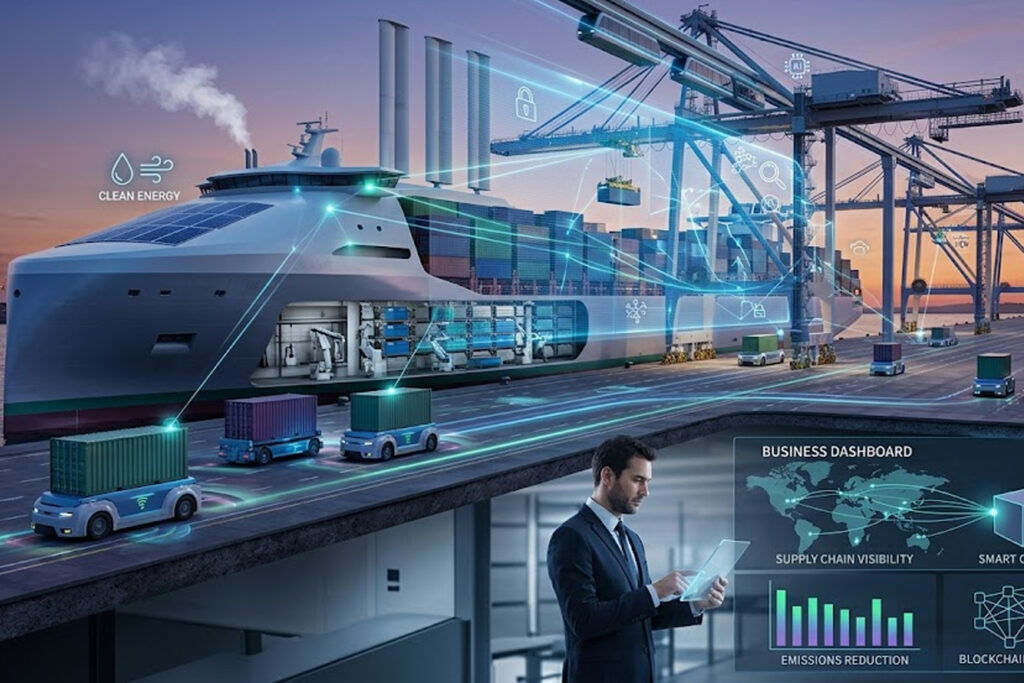
The convergence of green shipping mandates, digitalization, mega vessel deployment, supply chain restructuring, autonomous technology, port automation, and rising service expectations is creating a container shipping industry that will look and operate very differently in 2030 and 2035 than it does today. For businesses that depend on container shipping, the strategic implications are significant and span several dimensions.
Freight cost structures will change as green fuel premiums enter the market and carriers recover massive capital investment costs in new vessels and technology through their rate structures. Businesses that build green shipping cost trajectories into their supply chain financial models will be better prepared for this transition than those that assume current cost levels will persist.
Service reliability will improve on corridors served by advanced automated terminals and digitally coordinated port operations, but the transition period will involve disruption as investment is deployed and new operating models are established. Understanding which corridors and ports are ahead of or behind the curve on this investment will inform smarter routing decisions.
Supply chain geography will continue to shift as nearshoring, geopolitical decoupling, and sustainability considerations reshape where goods are produced and how far they travel. Container shipping route choices that made strategic sense in 2015 may need to be revisited in light of where manufacturing is relocating and which new trade corridors are growing.
Digital capability will increasingly determine which businesses get the most value from container shipping relationships. Shippers that invest in visibility platforms, digital documentation capabilities, and data-driven carrier performance management will consistently outperform those that manage ocean freight through manual processes and reactive exception management.
9. LTB Shipping: Preparing Your Supply Chain for What Is Coming
At LTB Shipping, we believe that the businesses best positioned for the future of container shipping are those that start preparing today. Our team monitors industry trends continuously and translates that intelligence into practical guidance for our clients about how to structure their shipping arrangements, carrier relationships, and logistics strategies for the changes ahead.
- Green shipping advisory services helping clients understand their Scope 3 freight emissions and options for certified green freight procurement
- Access to real-time cargo visibility platforms providing container-level tracking across all major trade lanes and carriers
- Proactive routing recommendations based on port performance intelligence, carrier reliability data, and emerging congestion or disruption indicators
- Contract negotiation support incorporating service level guarantees and performance metrics that reflect rising shipper expectations
- Alternative routing options across multiple carrier alliances providing flexibility when primary services are disrupted
- Dedicated account management ensuring that industry developments that could affect your supply chain reach you before they create operational problems
- Digital documentation management reducing paper-based process delays and customs clearance friction across all trade lanes
Our commitment to our clients is to be the partner that keeps their container shipping strategy current, their operations efficient, and their supply chains resilient as the industry transforms around them.
Conclusion
The future of container shipping is being written now, and the trends shaping it are not distant forecasts. They are developments actively unfolding in boardrooms, shipyards, port terminals, and regulatory chambers around the world. Green fuels are moving from trials to fleet-wide deployment strategies. Digital platforms are replacing paper processes at accelerating pace. Mega vessels are reshaping port infrastructure requirements. Supply chain geographies are shifting in response to geopolitical and sustainability pressures. And the standards that shippers expect from their ocean freight partners are rising steadily.
For businesses engaged in international trade, the response to these trends cannot be passive. Waiting to see how the industry evolves before adapting will mean being consistently behind the curve on cost management, service quality, and supply chain resilience. The businesses that engage proactively with these trends, invest in the capabilities they demand, and partner with logistics specialists who understand where the industry is heading will consistently outperform those that do not.
Container shipping has always been the foundation of global trade. Its future, though more complex and more demanding than its past, offers genuine opportunities for businesses that approach it with knowledge, strategy, and the right partners by their side.
Ready to future-proof your container shipping strategy? Contact LTB Shipping today and speak with our freight specialists about how we can help your business stay ahead of the trends reshaping global container shipping.