Recent Posts





Safety Standards & Best Practices | Liquid Cargo Transport Safety
December 15, 2025
Introduction
Imagine you’re loading a tank full of industrial solvent at a terminal in Karachi, poised for an ocean voyage to a chemical plant in Europe. One wrong move, improper fill levels, a missed inspection, a faulty valve, and your entire shipment could turn into a nightmare of spills, delays and reputational risk. That’s where liquid cargo transport safety becomes not just a compliance checkbox, but the bedrock of a successful logistics operation.
In this post, we’ll unpack the essential safety standards and best practices that define modern liquid cargo transport, from the design of tank containers to operational protocols, documentation, and on-the-ground execution. I’ll draw on research, share real-world reflections, and give you actionable guidance you can use right now.
Understanding the Landscape of Liquid Cargo Transport
Transporting liquids in bulk is more complex than moving dry goods. Liquids shift, expand, may react chemically or thermally, and often fall under hazardous‐goods regulations. Below are core aspects that shape safety for liquid cargo:
Why the risk is higher in liquid cargo transport
- Free surface effect: When a tank is partially filled, the liquid can slosh, destabilising the vehicle or vessel. The International Tank Container Organisation (ITCO) notes that tanks for hazardous liquids must adhere to strict filling levels to prevent overturn risk. ITCO+1
- Corrosive or reactive contents: Many liquid cargos are chemical in nature; materials, seals and tanks must be compatible and safe for the specific cargo.
- Multi-modal handling: Liquids often move via road, rail and sea; each mode adds its own hazards (vibration, pressure changes, temperature shifts).
- Cross-border compliance: You may need to meet standards for road (e.g., ADR in Europe), sea (e.g., IMDG code) and tank container design (e.g., ISO standards). For example, ISO 1496-3 is key for tank containers. Tank4Swap+1
The central role of ISO tank containers
Among the preferred vehicles for bulk liquid transport are ISO tank containers (also called tank-containers). They are built to international standards, are designed for multiple modes (road/rail/sea) and offer improved safety over drums or intermediate bulk containers (IBCs). Container xChange+1
Key advantages:
- Strong stainless steel shells and robust frames. ITCO+1
- Better integrity in multi-mode transport, fewer hand-offs and less chance of contamination or spillage.
- Standardised dimensions which make terminal handling more predictable.
In short, liquid cargo transport safety rests on equipment (tanks, valves), operations (loading, securing, monitoring) and regulatory compliance (standards, certification).
Key Safety Standards: What Every Operator Must Know
Here are the major safety standards and regulatory frameworks that frame best practices in liquid cargo transport.
Tank design & certification
- The container must comply with standards such as ISO 1496‑3 (for tank containers) and others like ISO 668 (classification). Tank4Swap+1
- According to ITCO, many tanks have multiple closures (two for low hazard, three for high hazard) to reduce leakage risk. ITCO
- Materials must resist corrosion and fatigue; manufacturing involves hydrostatic testing, leak testing, and ultrasonic thickness verification. Tank4Swap
- Filling levels must respect safety margins; ITCO states tanks must avoid extreme fill (~less than 20% or more than 80% in some cases) to avoid free surface sway. ITCO
Loading, handling & securing
- Proper loading is essential. Under-filling or over-filling can lead to pressure imbalance or slosh instability. hutchinsontransport.com+1
- Tanks must be handled using correct lifting points, never by the shell. Frame points only. Improper stacking or lifting has led to damage. hutchinsontransport.com
- Securing systems must prevent movement during road/rail/sea transit. One operator notes that “load securing and locking systems are crucial” for safe ISO tank movement. Arcon
Cleaning, hygiene, contamination control
- If a container switches from chemicals to food-grade liquids (or vice-versa), cleaning/decontamination is non-negotiable. ARCON notes explicit protocols. Arcon
- Tanks labelled “empty” or “uncleaned” must still be treated as if they held product; cleaning and certification before reuse is essential. ITCO
Regulatory compliance & documentation
- International regulations such as the European Agreement concerning the International Carriage of Dangerous Goods by Road (ADR), the International Maritime Dangerous Goods (IMDG) Code, and regional equivalents must be followed depending on cargo, mode and origin/destination. hutchinsontransport.com+1
- Documentation: Manufacturer’s certificate, inspection certificates, safety data sheets (SDS), and tank certification must be maintained. Tank4Swap
Real-time monitoring & technology
- With growing digitalisation, many operators are using sensors/IoT to monitor tank pressure, temperature, valve status and filling levels. The 2025 guide points out digital tools as best practice. Tank4Swap
- Environmental sustainability considerations are merging into safety, leak prevention, efficient tank reuse and emissions reduction are becoming criteria.
Operational culture & personnel training
- Safety isn’t just equipment, it’s people. The best operators enforce training for loading, securing, emergency response, and tank entry (if needed). ITCO specifies that tank entry should only occur when atmosphere monitoring is done, and a cleaning certificate is valid. ITCO
- Routine inspections and audit culture. Non-compliance (expired certificate, damaged shell) can lead to accidents, regulatory fines and insurance denial. Tank4Swap
Best Practices: From Ground Zero to Delivery
Having looked at standards, let’s translate those into operational best practices you can apply, based on my own experience working with logistics and tanker movements.
Step 1: Pre-shipment planning
- Cargo classification: Know whether your liquid is hazardous or non-hazardous; check compatibility with tank, material, seals, and linings.
- Tank selection: Choose an ISO tank rated for your cargo. If food-grade, ensure a segregated tank or dedicated cleaning. According to ARCON, choosing the right tank “based on the nature of the material being transported” is central to safety. Arcon
- Route and mode check: Will you move by road, rail, or sea? Does infrastructure (terminals, tank handling equipment) exist along the route? Choose mode(s) that support safe handling.
- Documentation and compliance: Ensure tank certificate, SDS, and cleaning certificate (if applicable) are valid. Pre-empt any local regulatory requirements at origin/destination.
Step 2: Loading & securing
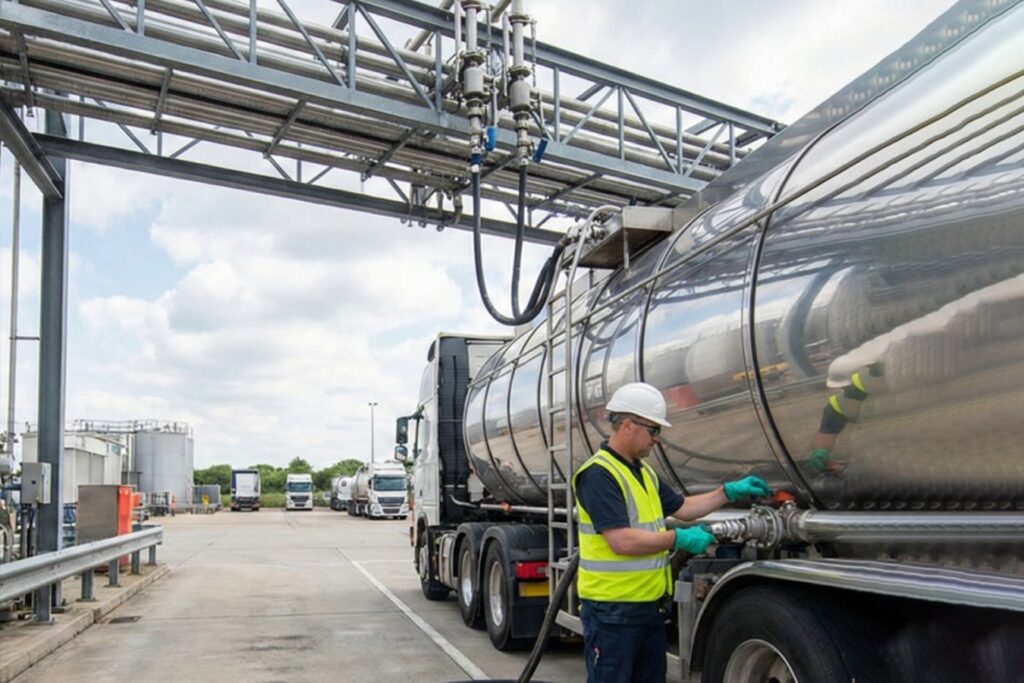
- At the loading site, supervise tank cleaning (if needed), verify valve integrity, check for corrosion, and confirm the correct fill level (not over or under).
- Use securing systems appropriate to the transport mode: e.g., twist locks for ISO tanks in shipping container stacks, proper lashings for road. ITCO emphasises proper securing to avoid movement. ITCO
- Label the tank clearly with UN number, hazard class, and content description. Mis-labelling is a frequent root cause of transport blocks or safety incidents.
Step 3: In-transit monitoring
- Monitor for unexpected events: temperature excursions, route delays, mode transfers (sea to road), switching terminals. Having tracking + real-time alerts gives early warning of risk.
- If using multi-modal transfer, check compatibility between modes (road → rail → sea) and ensure securing/re-securing is done at each hand-off.
Step 4: Arrival & delivery
- Verify tank condition before unloading: signs of damage, valve leaks, container imbalance.
- Ensure the unloading site is prepared: compatible for your liquid, has the right ground equipment, and staff are trained in handling the specific cargo.
- After delivery, cleaning or purging might be required (especially when switching products or modes). Maintain records.
Step 5: Post-shipment review & continuous improvement
- Debrief: What went right? What issues occurred? For example, maybe transit from an inland factory to a port was delayed due to poor road conditions, which influences future mode choice.
- Audit tank provider performance, driver/truck/rail operator reliability, and terminal handling quality.
- Update SOPs based on incident or near-miss data.
Use-Case Illustration: A Personal Logistics Reflection
As a logistics manager for a chemicals manufacturer exporting liquid additives, we once faced a tricky shipment: a 26,000-litre batch of speciality solvent bound for Europe. Initially, we considered drums, but the volume and hazard class pointed us to an ISO tank.
Here’s how we approached safety:
- We selected a certified ISO tank meeting ISO 1496-3 and cleaned it for chemicals. The provider showed inspection records and certification.
- We verified the tank had triple closures (given the hazard). According to ITCO guidelines, that’s required for high-hazard liquids. ITCO
- At loading, the site engineer insisted on filling the tank to 85% (leaving 15% headspace) specifically to control expansion during sea transit, an issue we had neglected in a previous shipment.
- During transit, we used a logistics tracking platform that alerted us when the tank switched from rail to road at a European inland terminal; we had pre-arranged the receiving terminal’s unloading equipment and driver training.
- Post-shipment review showed zero leak, no port demurrage, and despite a weather delay at sea added 2 days, our proactive securing meant no shifting of cargo.
- We rescoped SOPs: For future shipments, we mandated a pre-loading audit of tank certificates and a short training session for terminal handlers at the origin.
This hands-on experience confirmed: safety in liquid cargo transport is not just about ticking boxes, it’s about coordination, training, predictable hand-offs, and choosing the right tank + mode for the cargo.
Summary Table: Key Safety Standards vs Best Practices
Safety Standard Best Practice Action ISO 1496-3 (tank container design)Use only certified tanks, inspect structural integrity. Fill level limits / free surface control. Fill tank within safe range (avoid <20% or >80%). Valves & closures requirement (ITCO): Ensure the correct number of closures for the hazard class. Equipment securing & handling (ITCO)Use certified lifting gear & secure for each mode. Cleaning/contamination standard. Clean tanks thoroughly when switching products. Regulatory compliance (ADR, IMDG, etc.) Check documentation, hazard class, and local rules. Monitoring & documentation tracking, maintain inspection records. Training & culture: Train handlers, truck/rail/sea operator staff
Why Prioritising Liquid Cargo Transport Safety Pays Off
- Risk reduction: Accidents involving liquid cargo can lead to spills, environmental harm, regulatory fines and reputational damage.
- Cost efficiency: Prevention of incidents means fewer delays, lower insurance premiums, and less re-work or remediation.
- Market trust: Clients shipping high-value or sensitive liquids (chemicals, food-grade liquids) will prefer providers with a proven safety track record.
- Sustainability & compliance: With tougher environmental rules coming, safe and compliant transport becomes part of a logistics company’s competitive edge.
Conclusion
Liquid cargo transport safety is the intersection of robust equipment, disciplined operations and clear regulatory compliance. From selecting the right ISO tank to training your teams, from securing the load to maintaining detailed records, every step counts.
If you aim for excellence in logistics, especially when your cargo is liquid, volume-driven, and crosses borders, you can’t afford to view safety as optional or secondary. It’s central.
Call to Action:
Have you managed a liquid cargo shipment recently? Share your challenges or best practices in the comments below. We’d love to hear what’s worked (or not) in your region. And if you’re looking for a partner to help with ISO-tank logistics, inspections or training, reach out, we’re happy to help build your “liquid cargo transport safety” roadmap.